According to Silicon Labs, Z-Wave has been around for roughly 20 years, and yet a new generation of devices is advertising it with a fresh buzzword: “Long Range”. But not every device that makes this promise delivers the longer range in Europe.
This article explains how Z-Wave works, what separates the 700 and 800 series, what Z-Wave Long Range (LR or ZWLR for short) does differently, and what to look for when buying in the EU.
What is Z-Wave?
Z-Wave is a wireless standard for smart home devices such as sensors, switches, thermostats and door locks. It is defined as ITU standard G.9959 and developed further by the Z-Wave Alliance. According to the Alliance, more than 4,500 devices are certified.
Unlike Wi-Fi, Z-Wave transmits below 1 GHz. Silicon Labs, the main chip maker for Z-Wave, points out that these sub-GHz radio waves pass through walls well and reduce interference.
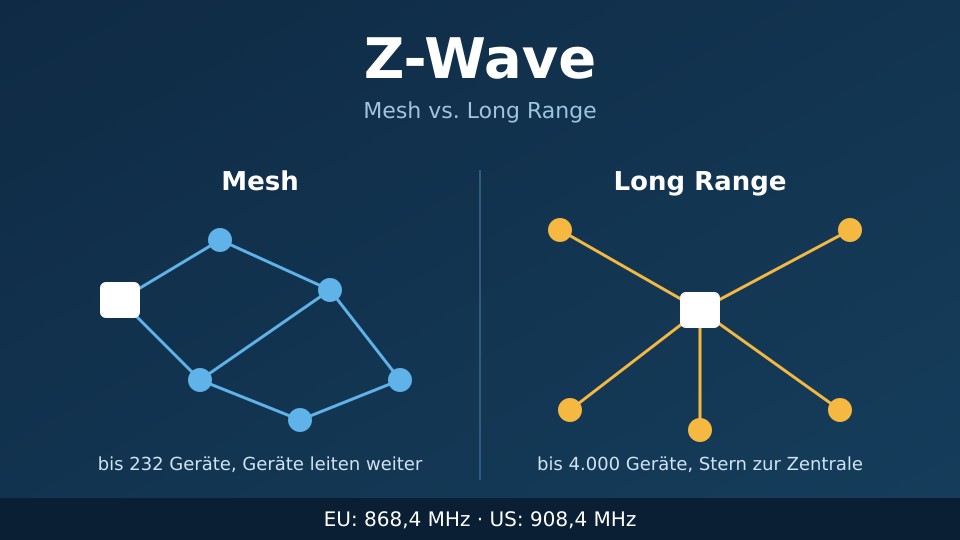
Classic Z-Wave builds a mesh network. Devices can act as repeaters and pass signals along until they reach their destination. The Alliance quotes roughly 100 metres per hop, and a network can hold up to 232 devices. Not every device forwards signals: the battery-powered Aeotec TriSensor 8, for example, is not a repeater according to its datasheet.
Frequencies: why there are EU and US devices
Z-Wave uses a different frequency depending on the country. According to Silicon Labs’ region table, every product has to use the frequency that applies in its region. The main regions:
- Europe (EN 300 220): 868.4 MHz and 869.85 MHz
- USA and Canada (FCC): 908.4 MHz and 916 MHz
- Australia and New Zealand: 919.8 MHz and 921.4 MHz
- Japan: 922.5 MHz, 923.9 MHz and 926.3 MHz
- India: 865.2 MHz
For buyers this means a US device transmits on a different frequency than a European hub. Manufacturers therefore make separate variants. For the TriSensor 8, Aeotec lists separate product types for the EU, US and AU.
700 and 800 series: the chip generations
The series names refer to chip generations from Silicon Labs. The 500 series is being phased out: since 1 January 2025, the Z-Wave Alliance no longer accepts new certifications for 500-series chips.
The 700 series brought Z-Wave Long Range. According to the Alliance, the first implementation ran on the 700 platform and was initially meant for the US market only.
The 800 series (ZG23 and ZGM230S chips) is the current generation. Silicon Labs quotes up to 50 percent longer battery life than the 700 series and up to ten years on a coin cell. It also brings S2 encryption and the Secure Vault security feature. According to Silicon Labs, 800-series chips are backward compatible with their predecessors.
Z-Wave Long Range: star instead of mesh
Long Range works fundamentally differently from classic mesh. LR devices operate in a star network: every device talks directly to the hub, and there is no routing through other devices.
In return, the range goes up. In the first implementation on the 700 platform, the Alliance reached 1.6 kilometres line of sight at +14 dBm transmit power. A network can hold up to 4,000 devices instead of 232. With dynamic power adjustment, sensors should run for up to ten years on a coin cell, according to the Alliance.
Mesh and Long Range are not mutually exclusive. Both kinds of device can run in the same network. You only get the full LR benefit, though, if both hub and device support Long Range.
| Feature | Z-Wave (mesh) | Z-Wave Long Range |
|---|---|---|
| Topology | Mesh, devices forward signals | Star, direct to the hub |
| Devices per network | up to 232 | up to 4,000 |
| Range | about 100 m per hop | 1.6 km line of sight (first 700-series implementation) |
| Range test value in certification | 75 m | 700 m |
| Security | S0, S2 | S2 only (Authenticated, Access Control) |
| Inclusion | also via the mesh | only within direct range |
| SmartStart via QR code | yes | yes |
| Max. LR transmit power (Connect ZWA-2) | – | EU +14 dBm, USA +20 dBm |
Does Long Range work in Europe?
Yes, but only for a short time and not with every device. The Z-Wave Alliance finished the LR specification for Europe on 29 February 2024. Since 6 May 2025, manufacturers can have devices certified for the new EU Long Range frequency.
One of the first LR end devices for Europe was the Aeotec SmokeShield. The module connects smoke alarms from Ei Electronics (Ei650iW and Ei650W) to a Z-Wave network, and Aeotec quotes up to 1 km of range in open field.
Ahead of Light + Building 2026, the Alliance presented more EU devices with LR. They include the EU versions of the Aeotec aërQ 8, Door/Window Sensor 8, MultiSensor 8 and Water Sensor 8, as well as new devices in the Shelly Wave series such as the Wave H&T EU LR and the Wave Motion EU LR. For Shelly, the Alliance says you decide during inclusion whether a device runs in the mesh or via LR.
The catch is in the fine print. “Long Range” on the box does not automatically mean it works in Europe. For the Aeotec TriSensor 8, the datasheet states explicitly: Long Range on the US frequency only. In Europe it runs as a regular mesh device.
If you want a motion, temperature and light sensor for the classic Z-Wave mesh, you can find the TriSensor 8 here:

- Bewegungsmelder mit 120° Sichtfeld und 10m Reichweite...
Last updated on 2026-11-20 / affiliate links / images from the Amazon Product Advertising API. Prices shown may have changed since then. All information without guarantee. * = affiliate link: if you order a product through such a link, we receive a commission from the seller. There are no extra costs for you.
The hub has to play along too. According to Nabu Casa, the Home Assistant Connect ZWA-2 adapter is set to the “EU Long Range” region at the factory. In Europe it transmits at a maximum of +14 dBm in LR mode, in the USA at +20 dBm. Outside the EU and the USA, there is no Long Range yet, says Nabu Casa.
More on the certified Aeotec devices in our article Aeotec is now “Works with Home Assistant”.
S2 and SmartStart: security and setup
S2 is the current security scheme of Z-Wave. According to the Alliance, Long Range devices use S2 exclusively, and the older S0 is not provided for. When you include a device with S2, Home Assistant may ask for a PIN, which is usually in the manual and on the device.
SmartStart makes inclusion easier. A QR code on the device or the packaging is scanned with the hub. In Home Assistant, the Z-Wave integration asks for LR-capable devices whether they should join the mesh or the network via Long Range. Switching later is only possible by removing the device and including it again.
Hubs: Home Assistant, Homey and Aeotec
Home Assistant: The Z-Wave integration is based on Z-Wave JS. When the radio region is set to “Automatic”, it uses Long Range where the region provides for it and the adapter supports it, according to the documentation. Manually, there are the options “Europe (Long Range)” and “USA (Long Range)”. Devices without LR can still be included.
Homey: The Homey Pro (2026) has Z-Wave built in. The Alliance describes its hardware as “ZWLR-ready” with 800-series technology.
Aeotec: Take a close look here. According to Aeotec, the older Smart Home Hub supports Z-Wave, while the newer Smart Home Hub 2 only supports Zigbee, Matter and Thread. For your own Z-Wave projects, Aeotec offers the Z-Stick 10 Pro USB controller.
And what does Z-Wave have to do with Matter?
Z-Wave devices do not speak Matter. According to Homey, you need a hub that translates between the two. The Z-Wave Alliance also relies on such bridges to connect Z-Wave devices with Matter.
Homey shows what that looks like: the Matter Bridge app passes Z-Wave devices on to Apple Home or Google Home. The devices stay paired with Homey, though, and Matter only gets a standardised set of functions, not every Z-Wave feature.
What to look for when buying
- Buy the EU variant: Europe uses 868.4 and 869.85 MHz, and the hub has to use the same region.
- Check “Long Range”: Look in the datasheet for an EU LR variant. If it says “US frequency only”, the device runs in the mesh here.
- Check the hub: LR only works if the adapter or hub supports Long Range too.
- Don’t write off the mesh: LR devices do not forward signals. According to Home Assistant, a new mesh device can improve coverage and reliability of an existing mesh network.
More Z-Wave devices, from sensors to hubs, are in the product overview.