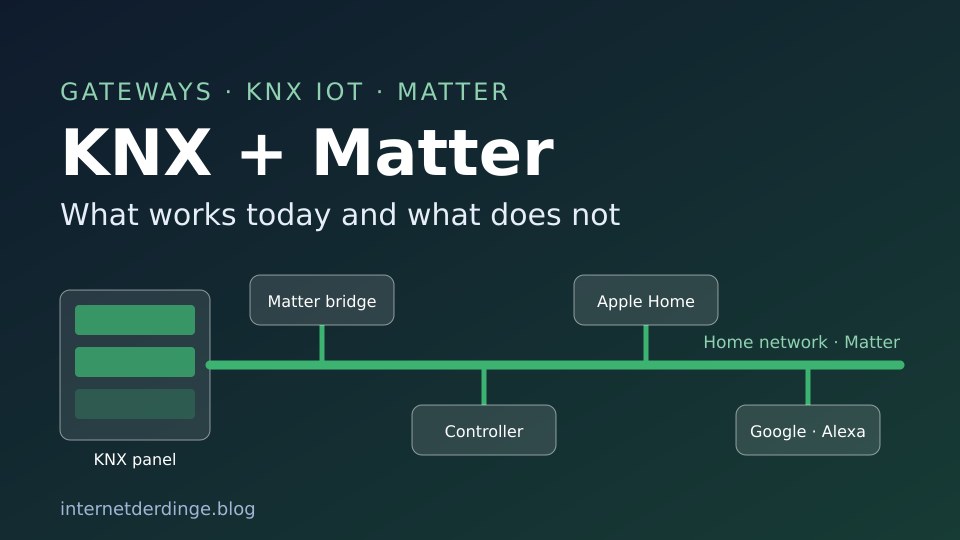
KNX controls lighting, blinds and heating over a wired bus inside the building. Matter brings devices from different brands into Apple Home, Google Home, Alexa and SmartThings. The two can be connected, but not directly: a gateway sits in between, usually a so-called Matter bridge mounted in the distribution board.
This article covers what the KNX Association says about Matter, what KNX IoT has to do with it, which gateways exist and what actually reaches Matter. It is based on publications of the KNX Association, the certification database of the Connectivity Standards Alliance (CSA) and manufacturer documentation, as of 20 November 2026. How KNX works in general is explained in KNX explained.
In short
- KNX devices do not speak Matter. A gateway from a manufacturer handles the connection. We did not find an official Matter bridge from the KNX Association itself.
- The CSA database currently lists nine Matter-certified bridges related to KNX, including products from Elsner, 1Home, Hager, ABB/Busch-Jaeger, Atios and xxter.
- Most of them bring KNX to Matter. Only some can also bring Matter devices into the KNX installation.
- For Apple Home, Google Home and Alexa you also need a Matter controller, such as a HomePod, a Google hub or a suitable Echo device.
- KNX IoT is not Matter. It is an IPv6 extension of KNX that also uses Thread, but it is configured in ETS.
What the KNX Association says about Matter
The KNX Association set out its view in a position paper on Matter in March 2024. It describes KNX as the “essential backbone of the smart home”. According to the paper, Matter can extend a KNX home with devices you buy rather than install: TVs, streaming devices, white goods, lamps and smart sockets.
The paper also lists limits. Matter is not an EN or ISO standard, while KNX products comply with ISO/IEC and EN standards. Matter only allows partial connectivity between brands, and settings and automations usually run through the app of the chosen hub. A common commissioning tool like ETS is missing. The KNX Association explicitly acknowledges Matter’s focus on security and privacy.
In April 2026, Hestia Magazine, published by the KNX Association, followed up. It says Matter devices rely on a Matter controller such as a HomePod or a Nest Hub, which becomes a “single point of failure”. Detailed energy monitoring, advanced HVAC coordination and specialised sensors often still need the manufacturer’s app. The recommendation: KNX as the foundation, Matter on top for flexible devices and voice assistants.
The CSA, the organisation behind Matter, does not see Matter as a replacement either. Its FAQ says: “Matter is not a replacement; it is a unification layer.”
KNX IoT is not Matter
The name is easy to misread. According to the KNX Association, KNX IoT is an extension of KNX that can run alongside twisted pair, KNX RF and KNXnet/IP. It uses an open IPv6 layer over Ethernet, Wi-Fi and Thread. KNX IoT devices are commissioned in ETS like other KNX devices, with credentials similar to KNX Secure. Connecting them to an existing installation requires a KNX IoT Router.
There are two building blocks:
- KNX IoT 3rd Party API: a standardised interface for third parties, for example cloud services, based on the information model exported by ETS6.
- KNX IoT Point API: sensors and actuators that communicate directly via IPv6 over Thread or Wi-Fi.
The first KNX IoT devices came out in 2023 from Siemens, Passiv Energie and Cascoda, all using Thread. An official certification scheme has existed since November 2024, and the KNX Association names the ATOUCH Glass Panels as the first external certification. KNX Standard v3.0.5 from September 2026 aligned the test specifications for the 3rd Party API, the Point API and the KNX IoT Router.
In practice, KNX IoT and Matter share Thread and IPv6 as a basis, but they are different protocols. A KNX IoT device does not show up in Apple Home on its own. We did not find an official statement from the KNX Association that KNX IoT and Matter work together. More on Matter and Thread is available in our Matter section and in Matter over Wi-Fi or Thread?.
How a KNX Matter bridge works
A Matter bridge translates between two worlds. On one side it is connected to the KNX bus or the KNX IP installation, on the other side it appears on the home network as a Matter device. In the Matter data model this type of device is called an “Aggregator”. Every light, blind and thermostat behind it shows up as a separate device in the home app.
To know what sits behind which group address, many bridges read the ETS project. According to the manufacturers, 1Home and Elsner detect devices automatically from the ETS project file, and xxter Pairot can import the ETS project in its customer portal. The Atios KNX Bridge is set up in a web interface without ETS, according to Atios, and Busch-VoiceControl is also commissioned entirely in the browser.
The bridge is usually not a Matter controller. Hager states this explicitly for domovea: it is a Matter bridge, not a Matter controller. The controller comes from the respective ecosystem.
Which KNX Matter gateways exist
Searching for “KNX” in the CSA certification database returns nine Matter-certified bridges (as of 20 November 2026). The Matter version is the one the device was certified with.
| Product | Manufacturer | Matter (CSA) | Direction | Notes from the manufacturer |
|---|---|---|---|---|
| KNX Matter Server (71256) | Elsner Elektronik (powered by 1Home) | 1.1 | KNX → Matter, Matter → KNX | identical to 1Home Server KNX Pro, no KNX Secure |
| 1Home Server KNX Pro / KNX | 1Home | 1.1 | KNX → Matter, Matter → KNX on Pro only | up to 250 (Pro) or 90 devices, no KNX Secure |
| domovea basic (TJAS671) / plus (TJAS471) | Hager | 1.1 | KNX → Matter only | lights, sockets, blinds, thermostats, sensors |
| Busch-VoiceControl (VCO/S150.2) | ABB / Busch-Jaeger | 1.4 | KNX → Matter, Matter → KNX | up to 150 functions, set up in the browser |
| KNX Bridge | Atios (Switzerland) | 1.1 | KNX → Matter | also KNX IP interface and KNX DALI gateway, KNX Secure |
| Pairot | xxter (Netherlands) | 1.4 | KNX → Matter | ETS project import, no subscription or licence fees |
| Pandora Edge | Nanjing Lingkemi | 1.6 | KNX → Matter, Matter → KNX | information from the CSA database only |
| Magical.Homes Max Bridge | Longan Link | 1.3 | KNX → Matter | multi-protocol bridge, information from the CSA database only |
Hager domovea basic and plus are two entries in the CSA database; the table shows them in one row.
Elsner KNX Matter Server and 1Home Server
According to Elsner, the Elsner KNX Matter Server is identical to the 1Home Server KNX Pro. It mounts on a DIN rail (4 modules), needs an external 12 to 30 V DC supply and includes a KNX IP interface with up to four tunnels.
According to 1Home, up to 250 devices can be bridged to Matter, where one device means one light, thermostat or blind. In the other direction, up to 100 Matter devices can be assigned group addresses and then used in ETS. The server runs locally and only needs internet briefly for updates, according to the manufacturer. Voice control, however, requires an internet connection.
One important limitation: according to its own documentation, the 1Home Server currently does not support KNX Secure, neither IP Secure nor Data Secure. As a workaround, 1Home suggests disabling Secure for individual devices or group addresses.
Hager domovea
At Hager, the domovea basic or plus visualisation server handles the bridge function. According to Hager, lighting (on/off, dimming), switchable sockets, roller shutters and blinds (open and close), thermostats and sensors for temperature, humidity and binary inputs are made available to Matter. Up to three ecosystems can be paired in parallel. Groups and automations from domovea are currently not shared with the assistants, and Matter devices cannot be brought into domovea.
Busch-VoiceControl
According to ABB/Busch-Jaeger, Busch-VoiceControl 2 integrates up to 150 KNX functions, including lighting, blinds and room temperature. The device now has a bidirectional Matter gateway, so it also brings Matter devices such as window contacts, sockets or push-buttons into the KNX installation. It needs a 10 to 36 V DC supply.
Atios KNX Bridge and xxter Pairot
The Atios KNX Bridge from Switzerland combines a Matter bridge, a KNX IP interface and a KNX DALI gateway. According to Atios, it supports IP Secure and Data Secure and is powered via PoE or 20 to 30 V DC. Pairot from xxter in the Netherlands imports the ETS project and comes without subscription or licence fees, according to the manufacturer.
Gira, JUNG, MDT and others
For Gira, JUNG, MDT, Weinzierl, Zennio, Theben and Siemens we found no KNX Matter bridge, neither in the CSA database nor on the manufacturers’ websites. JUNG has a Matter-certified wireless push-button, but it is not a KNX bridge. For IPv6 and Thread, Siemens relies on KNX IoT.
What reaches Matter and what does not
Matter has its own device types, for example lights, plugs, window coverings, thermostats, door locks and sensors. A KNX function only shows up in Apple Home and the like if the bridge can map it to one of these types.
For the 1Home Server, its documentation lists: switching, dimming, tunable white, RGB, thermostat, socket, roller shutter and venetian blind, door lock, push-button, contact, temperature, brightness, presence and humidity sensors, plus scenes. Energy meters, wind speed, rain, diagnostic messages and alarm status are not passed to Matter. These values only appear in 1Home’s own app.
A typical pitfall is also covered in the 1Home documentation: apps use absolute dimming (1 byte). If only relative dimming (4 bit) has been set up in ETS, brightness cannot be set from the home app. In addition, the status objects need the read and transmit flags.
Do I need a hub?
In practice, yes. Hager lists a Matter controller such as Apple TV, HomePod, Google Nest Hub, Samsung SmartThings or an Alexa device as a requirement, and 1Home states “Hub required” for every ecosystem.
- Apple: According to Apple Support, Matter accessories in the Home app require a home hub, i.e. a HomePod or Apple TV. Another Apple Support page says that from iOS 18 Matter accessories can also be added without a home hub, but still recommends one. According to Apple, a home hub is needed for remote control and automations.
- Google: According to Google, adding Matter devices requires a Matter-enabled hub, for example Nest Hub (2nd gen), Nest Hub Max, Nest Wifi Pro or Google TV Streamer.
- Amazon: According to Amazon, the Echo Hub has a built-in smart home hub for Matter and Thread.
With Matter multi-admin, the same bridge can be connected to several systems at once, with Hager for example up to three.
KNX Matter servers are not available on Amazon. A Matter controller with Thread such as the Echo Hub is:


Last updated on 2026-11-20 / affiliate links / images from the Amazon Product Advertising API. Prices shown may have changed since then. All information without guarantee. * = affiliate link: if you order a product through such a link, we receive a commission from the seller. There are no extra costs for you.
KNX, Matter and Home Assistant
Home Assistant can integrate KNX directly through its own KNX integration. How that works is explained in How to connect KNX to Home Assistant. There is also a Matter integration that makes Home Assistant a Matter controller, which can also add Matter bridges from other manufacturers.
The other way round is not officially supported. According to the documentation, Home Assistant is not a Matter bridge itself and cannot turn existing devices into Matter devices. So KNX devices in Home Assistant do not reach Apple Home via Matter. Only a community project, Home-Assistant-Matter-Hub, does that, and it is not an official part of Home Assistant.
For Home Assistant, 1Home itself recommends the classic KNX integration: according to the manufacturer, the server can simply be used as a KNX IP interface. Via Matter, Home Assistant has problems from around 80 devices, the documentation says (as of August 2024).
What about Loxone?
Loxone is a CSA member and offers a Matter plugin, currently version 0.4.1 in the Config 17.3 beta. However, Loxone still calls the integration experimental, does not recommend it for customer installations and does not provide support for it. The Miniserver only acts as a bridge, not as a controller, and according to Loxone’s documentation exposes the first 200 function blocks. More in Loxone Miniserver explained and in the comparison KNX vs Loxone.
FAQ
Does Matter replace KNX? No. The KNX Association sees KNX as the backbone and Matter as an extension, and the CSA calls Matter a unification layer, not a replacement.
Does KNX Secure work through a Matter bridge? It depends on the device. Atios supports IP Secure and Data Secure, 1Home and therefore Elsner currently do not. For Hager, ABB, xxter and Pandora we found no manufacturer statement on this.
Can I use Matter devices in KNX? With some gateways, yes: 1Home Server KNX Pro and Elsner (up to 100 devices), Busch-VoiceControl and, according to its CSA entry, Pandora Edge. According to Hager, domovea cannot do this.
Do I need ETS? For the KNX installation itself, yes. Many bridges import the ETS project, while Atios and Busch-VoiceControl are set up in the browser.
Verdict
KNX and Matter are not mutually exclusive. The KNX installation stays the foundation, and a certified bridge brings lighting, blinds, heating and sensors into Apple Home, Google Home or Alexa. When choosing one, three points matter: whether the bridge supports KNX Secure, whether it can also bring Matter devices into KNX, and which functions it actually translates to Matter. You need a Matter controller in addition in any case.
If you are building new, plan the network cable to the distribution board from the start, see KNX in a new build. More articles are in our KNX & Loxone section.